ENTERPRISE PLATFORM
MITRATECH
Distributor Configuration Templates
Tracker I-9 was growing through its partner channel. More distributors, more clients, more I-9 compliance work to configure. But every new client meant a distributor admin was either wrestling with a 50-argument API payload or calling our support team for help. The support ceiling was real. I led the UX design on Distributor Packages, the system that removed it.
MY ROLE
Product Designer
MY ROLE
Product Designer
MY ROLE
Product Designer
MY ROLE
Product Designer
MY ROLE
Product Designer
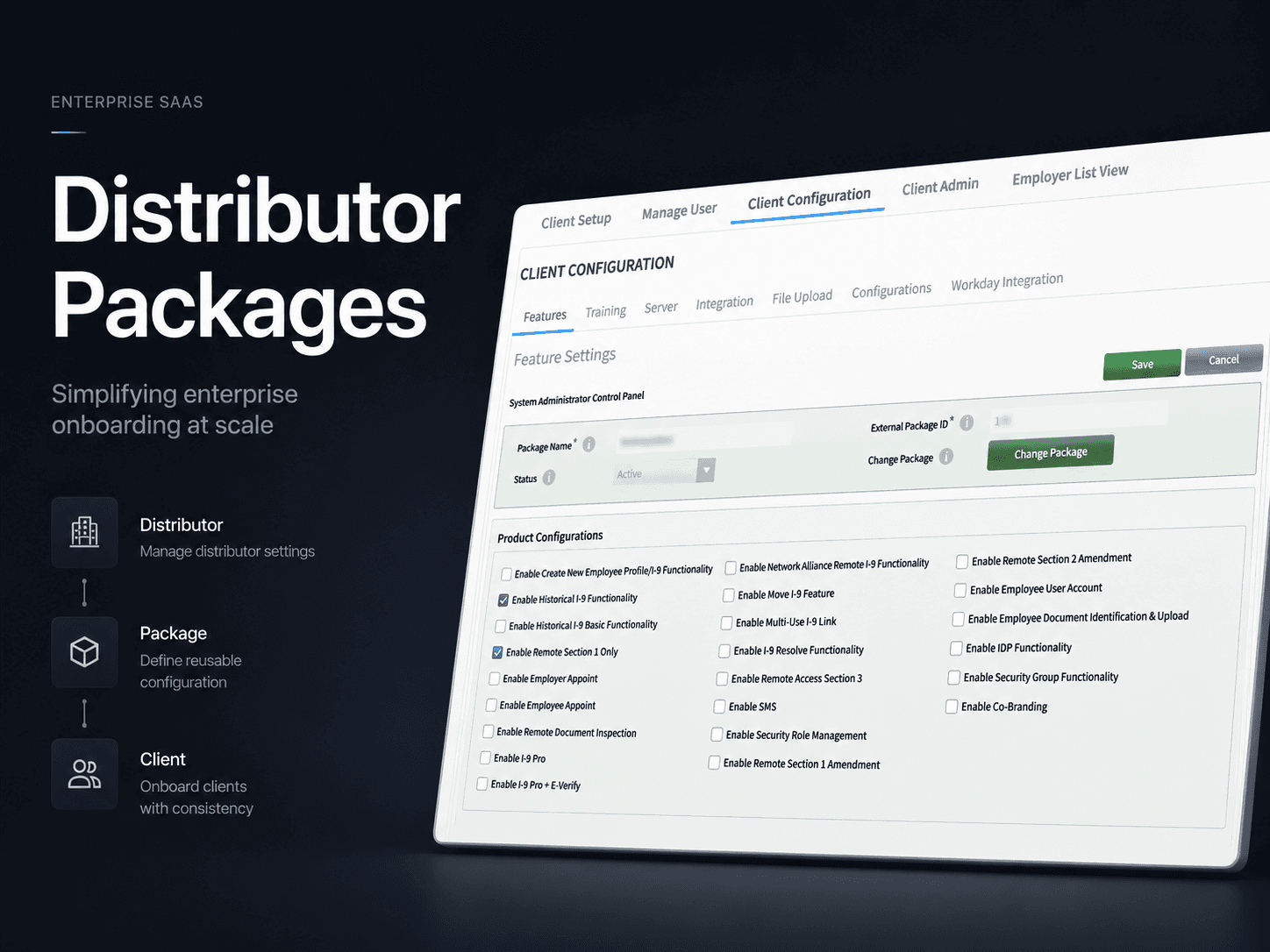
Overview
Mitratech is an enterprise legal and compliance software company whose platform enables financial services distributors to manage client relationships at scale. A core part of that platform is the distributor onboarding system — a highly flexible API that allows distributors to configure new clients with precise operational settings before they go live.
The problem was that flexibility had become friction. Each new client onboarding required a distributor developer to manually configure approximately 50 JSON payload arguments from scratch — even when that client was operationally nearly identical to dozens before it. There was no way to save, reuse, or templatize prior work. Every implementation started at zero.
I was brought in as the lead product designer on a cross-functional initiative to fix the onboarding experience. The project was framed initially as "the API is too complex — simplify it." My most important contribution happened before any design began: I identified that the complexity wasn't the real problem. The repetition was. That reframe shaped everything — the solution direction, the system architecture, and the governance model we built around it.
The result was a three-layer Configuration Template system that let distributors encode their standard setup once and assign it across clients. Per-client work reduced to selective overrides. The longest onboarding bottleneck became one of the most predictable phases of the implementation process.
~50
JSON arguments configured manually per client before templates
2–3×
Implementation review cycles before configurations stabilized for QA
3
User groups affected across developers, PMs, and Services teams
↓
Services dependency as distributor onboarding volume scaled
01 - THE PROBLEM
What looked like an API problem was actually an operational one
Mitratech's distributor onboarding relied on highly flexible Create Client and Update Client APIs. Distributors configuring new clients had to manually manage approximately 50 JSON payload arguments per implementation. The initial framing across product and engineering was that the API was simply too complex.
During discovery, I identified a more important behavioral pattern beneath that surface complaint
"
Implementation stakeholder, distributor onboarding review
The Reframe I Advocated For
The real problem wasn't "50 fields are difficult." It was "the same setup work is repeated over and over." That shift — which I pushed for in early product discussions — changed the solution direction entirely. Instead of removing flexibility from the API, distributors needed a way to encode that flexibility once and reuse it at scale.
Mitratech's distributor onboarding relied on highly flexible Create Client and Update Client APIs. Distributors configuring new clients had to manually manage approximately 50 JSON payload arguments per implementation. The initial framing across product and engineering was that the API was simply too complex.
During discovery, I identified a more important behavioral pattern beneath that surface complaint
Constraints I was designing within
TECHNICAL
Backward compatibility was non-negotiable
Distributors already using the existing API could not be forced to change how they worked. Any solution had to be additive. The existing Create Client and Update Client API calls had to keep working exactly as before.
BUSINESS GOAL
Accelelerate time - to- time- Transaction revenuse
Onboarding speed directly affected when distributors could activate clients and begin generating transaction revenue. Every review cycle added days to that timeline. The business goal was to compress the Create Client phase significantly without rebuilding the API.
OPERATIONAL GOAL
Accelelerate time - to- time- Transaction revenuse
Onboarding speed directly affected when distributors could activate clients and begin generating transaction revenue. Every review cycle added days to that timeline. The business goal was to compress the Create Client phase significantly without rebuilding the API.
DESIGN GOAL
Accelelerate time - to- time- Transaction revenuse
Onboarding speed directly affected when distributors could activate clients and begin generating transaction revenue. Every review cycle added days to that timeline. The business goal was to compress the Create Client phase significantly without rebuilding the API.
01B — GOALS & SUCCESS METRICS
What success looked like going in
Before any design work began, the team aligned on what we were actually trying to achieve — and how we'd know if we got there. These goals shaped every subsequent design decision.
USER GOAL
Accelelerate time - to- time- Transaction revenuse
Onboarding speed directly affected when distributors could activate clients and begin generating transaction revenue. Every review cycle added days to that timeline. The business goal was to compress the Create Client phase significantly without rebuilding the API.
BUSINESS GOAL
Accelelerate time - to- time- Transaction revenuse
Onboarding speed directly affected when distributors could activate clients and begin generating transaction revenue. Every review cycle added days to that timeline. The business goal was to compress the Create Client phase significantly without rebuilding the API.
OPERATIONAL GOAL
Accelelerate time - to- time- Transaction revenuse
Onboarding speed directly affected when distributors could activate clients and begin generating transaction revenue. Every review cycle added days to that timeline. The business goal was to compress the Create Client phase significantly without rebuilding the API.
DESIGN GOAL
Accelelerate time - to- time- Transaction revenuse
Onboarding speed directly affected when distributors could activate clients and begin generating transaction revenue. Every review cycle added days to that timeline. The business goal was to compress the Create Client phase significantly without rebuilding the API.

~50
JSON arguments configured manually per client before templates
2–3×
Implementation review cycles before configurations stabilized for QA
3
User groups affected across developers, PMs, and Services teams
3
User groups affected across developers, PMs, and Services teams
↓
Services dependency as distributor onboarding volume scaled
USER GOAL
Accelelerate time - to- time- Transaction revenuse
Onboarding speed directly affected when distributors could activate clients and begin generating transaction revenue. Every review cycle added days to that timeline. The business goal was to compress the Create Client phase significantly without rebuilding the API.
OPERATIONAL GOAL
Accelelerate time - to- time- Transaction revenuse
Onboarding speed directly affected when distributors could activate clients and begin generating transaction revenue. Every review cycle added days to that timeline. The business goal was to compress the Create Client phase significantly without rebuilding the API.
BUSINESS GOAL
Accelelerate time - to- time- Transaction revenuse
Onboarding speed directly affected when distributors could activate clients and begin generating transaction revenue. Every review cycle added days to that timeline. The business goal was to compress the Create Client phase significantly without rebuilding the API.
DESIGN GOAL
Accelelerate time - to- time- Transaction revenuse
Onboarding speed directly affected when distributors could activate clients and begin generating transaction revenue. Every review cycle added days to that timeline. The business goal was to compress the Create Client phase significantly without rebuilding the API.
02 — USERS & STAKES
Three teams. One shared bottleneck.
The onboarding problem touched three user groups, each experiencing the same friction differently. Understanding what professional failure looked like for each shaped where the system needed the most careful design attention.

USER GOAL
Accelelerate time - to- time- Transaction revenuse
Onboarding speed directly affected when distributors could activate clients and begin generating transaction revenue. Every review cycle added days to that timeline. The business goal was to compress the Create Client phase significantly without rebuilding the API.
OPERATIONAL GOAL
Accelelerate time - to- time- Transaction revenuse
Onboarding speed directly affected when distributors could activate clients and begin generating transaction revenue. Every review cycle added days to that timeline. The business goal was to compress the Create Client phase significantly without rebuilding the API.
BUSINESS GOAL
Accelelerate time - to- time- Transaction revenuse
Onboarding speed directly affected when distributors could activate clients and begin generating transaction revenue. Every review cycle added days to that timeline. The business goal was to compress the Create Client phase significantly without rebuilding the API.
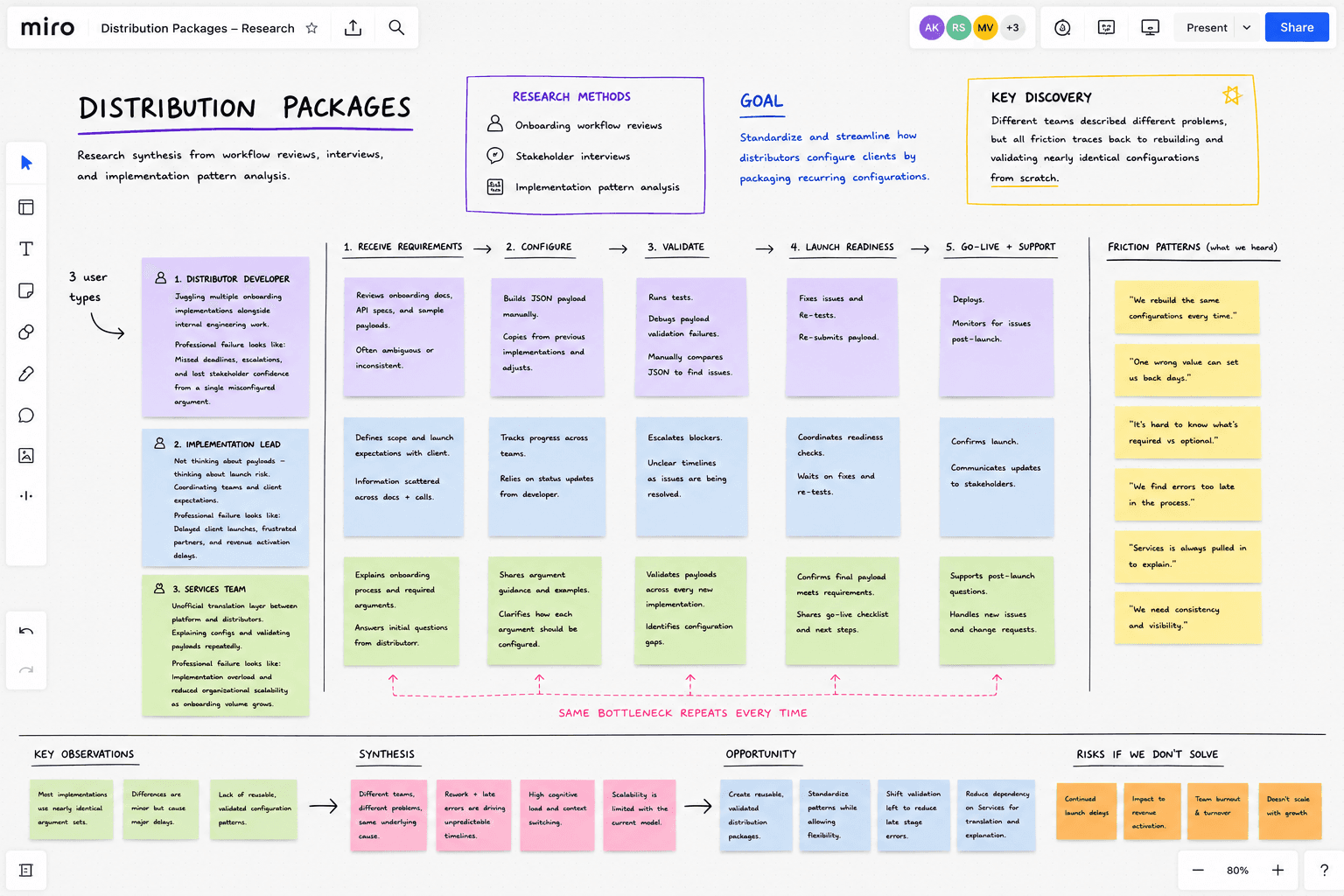
Onboarding speed directly affected when distributors could activate clients and begin generating transaction revenue. Every review cycle added days to that timeline. The business goal was to compress the Create Client phase significantly without rebuilding the API.
03a — BRAINSTROMING & IDEATION
Three teams. One shared bottleneck.
Discovery had given us the reframe. The harder question was what to actually build. The solution direction didn't arrive fully formed — it emerged through a process of elimination, pattern recognition, and close collaboration with product and engineering.
Onboarding speed directly affected when distributors could activate clients and begin generating transaction revenue. Every review cycle added days to that timeline. The business goal was to compress the Create Client phase significantly without rebuilding the API.
Onboarding speed directly affected when distributors could activate clients and begin generating transaction revenue. Every review cycle added days to that timeline. The business goal was to compress the Create Client phase significantly without rebuilding the API.
Onboarding speed directly affected when distributors could activate clients and begin generating transaction revenue. Every review cycle added days to that timeline. The business goal was to compress the Create Client phase significantly without rebuilding the API.
Onboarding speed directly affected when distributors could activate clients and begin generating transaction revenue. Every review cycle added days to that timeline. The business goal was to compress the Create Client phase significantly without rebuilding the API.
Onboarding speed directly affected when distributors could activate clients and begin generating transaction revenue. Every review cycle added days to that timeline. The business goal was to compress the Create Client phase significantly without rebuilding the API.
03b — EXPLORATION
What I considered before committing
With the problem reframed and the user pain points mapped, the next challenge was choosing the right abstraction. Three directions were explored seriously before templates became the answer.
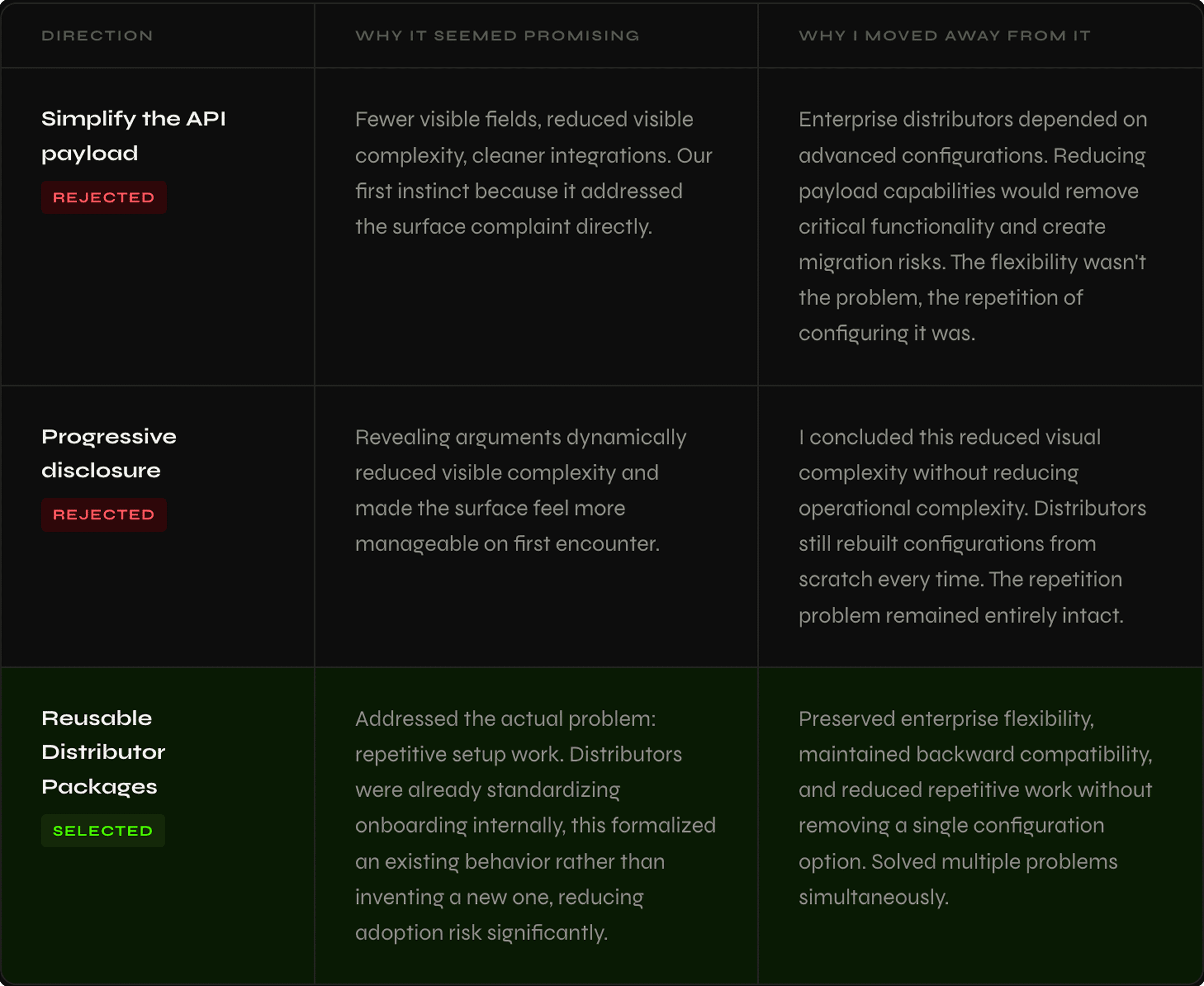
→
What formal usability testing would have added
The real problem wasn't "50 fields are difficult." It was "the same setup work is repeated over and over." That shift — which I pushed for in early product discussions — changed the solution direction entirely. Instead of removing flexibility from the API, distributors needed a way to encode that flexibility once and reuse it at scale.
Onboarding speed directly affected when distributors could activate clients and begin generating transaction revenue. Every review cycle added days to that timeline. The business goal was to compress the Create Client phase significantly without rebuilding the API.
04 — BEFORE & AFTER
The operational shift, made concrete
Before — Every Client Implementation
1
Manually write ~50 JSON arguments from memory
or documentation for each new client
2
Submit payload, receive validation failures, debug
which argument was wrong or missing
3
Join clarification sessions with Mitratech Services
to resolve configuration gaps
4
2–3 implementation review rounds before
configurations stabilized for QA
5
Repeat the entire process for the next client —
even when configurations were nearly identical
Delayed activation · Revenue held · Escalations
After — Template-Driven Onboarding
1
Create a reusable configuration template once,
encoding standard operational setup for a client
type
2
Assign template to new client — defaults
propagate automatically
3
Apply controlled overrides only where the client
genuinely differs from the standard
4
Configurations validated against known-good
template baseline — fewer QA cycles required
5
Next client: assign template, override as needed,
activate. Setup work is not repeated.
Faster activation · Reduced dependency · Scalable
ops
05 — ROLE & OWNERSHIP
What I drove. What we built together.
With the problem reframed and the user pain points mapped, the next challenge was choosing the right abstraction. Three directions were explored seriously before templates became the answer.
Ownership Map
Distinguishing what I personally drove from what was genuinely collaborative
I personally drove
Reframing the problem from API simplification to reducing
repetitive operational work
Advocating for controlled overrides over strict template
inheritance
Workflow architecture for the template management and
client-level experiences
Governance UX decisions — deactivation flows, warning
states, reassignment behavior
Recommending operational consistency over UI novelty in
the design direction
Implementation consistency reviews and design QA through
release
Collaborative with the team
Overall product initiative scope and phasing — PM-led with
design input
API architecture decisions and technical feasibility —
engineering-led
Propagation rules and conflict handling logic — engineering
with design review
QA test coverage and release criteria — QA-led with design
QA support
Services team enablement and rollout communication —
Services-led
05 — ROLE & OWNERSHIP
What I drove. What we built together.
With the problem reframed and the user pain points mapped, the next challenge was choosing the right abstraction. Three directions were explored seriously before templates became the answer.
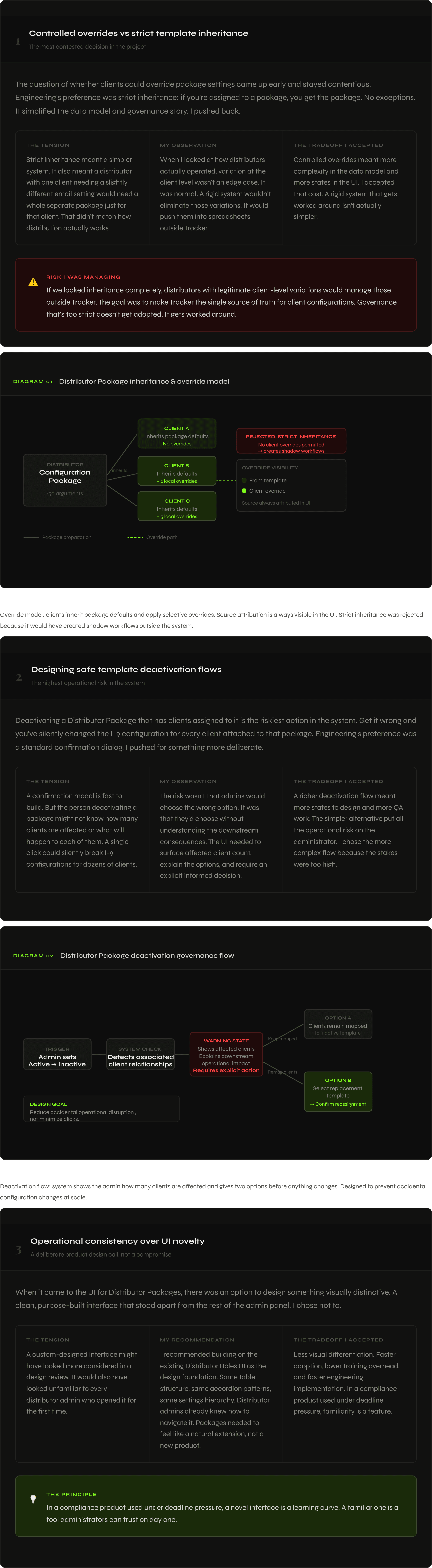
Onboarding speed directly affected when distributors could activate clients and begin generating transaction revenue. Every review cycle added days to that timeline. The business goal was to compress the Create Client phase significantly without rebuilding the API.
07 — SYSTEM ARCHITECHTURE
Three layers. One connected system.
Once templates became the direction, the design problem shifted from "how do we simplify a screen?" to "how do we safely manage configuration relationships at enterprise scale?" That introduced systems-thinking challenges — propagation behavior, inheritance logic, override handling, governance — that had nothing to do with individual UI components.
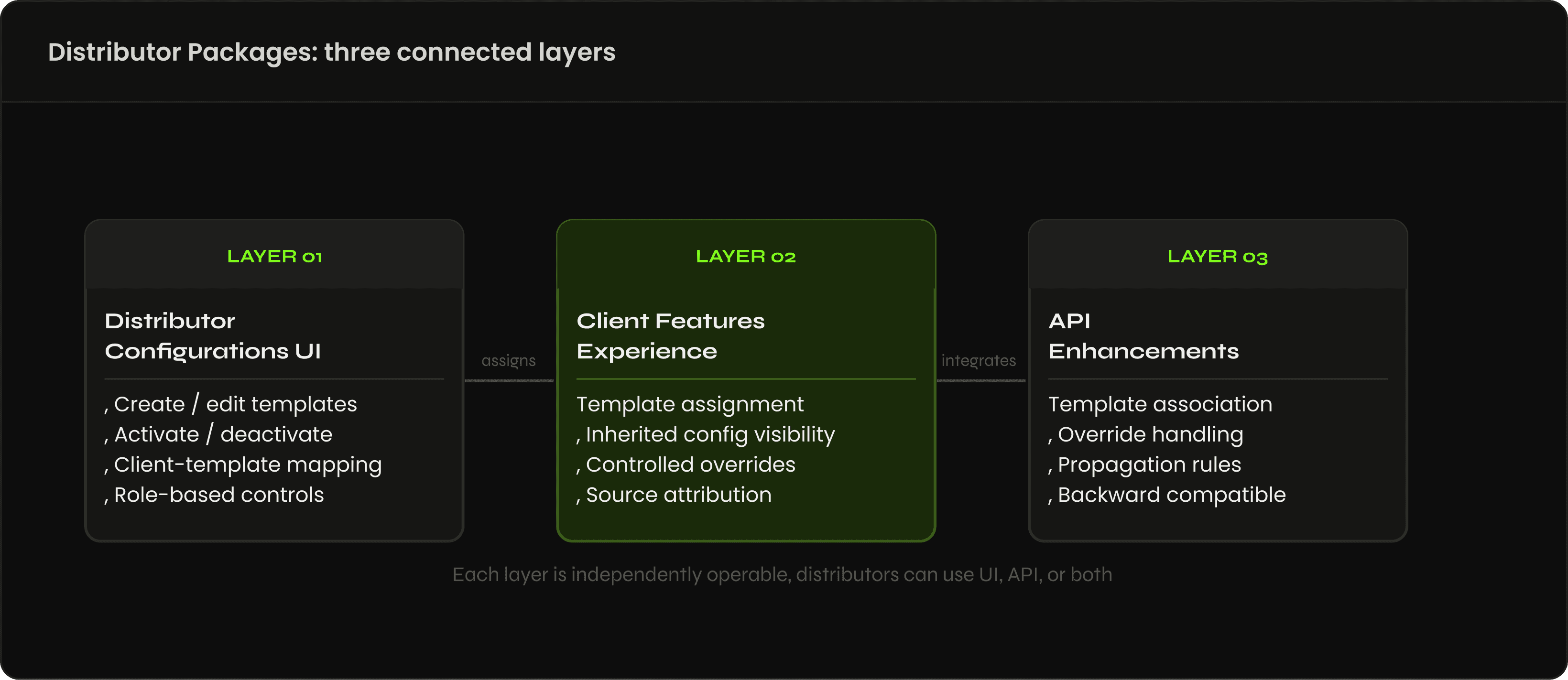
Onboarding speed directly affected when distributors could activate clients and begin generating transaction revenue. Every review cycle added days to that timeline. The business goal was to compress the Create Client phase significantly without rebuilding the API.
08 — ACCESSIBLITY & IMPLEMENTATION
Enterprise clarity as a design requirement
Accessibility became especially important because administrators relied heavily on operational clarity — often under time pressure, scanning for status information quickly. In enterprise systems, predictability and clarity matter more than visual decoration.
Onboarding speed directly affected when distributors could activate clients and begin generating transaction revenue. Every review cycle added days to that timeline. The business goal was to compress the Create Client phase significantly without rebuilding the API.
⌨️
Keyboard navigation
Full keyboard operability for all template management and client assignment workflows. Critical for administrators who live in dense operational interfaces.
🏗
Semantic grouping hierarchy
Configuration panels grouped semantically so screen readers and keyboard users can orient themselves within complex template structures without visual context.
👁
Visible disabled states
Clearly communicated inactive template states and permission-restricted interactions — essential for governance visibility in multi-role enterprise environments.
📊
Accessible table structures
Template management tables built with proper ARIA roles and column headers. Administrators scanning large client lists needed reliable, predictable navigation.
🎨
WCAG-compliant contrast
All status indicators, warning states, and override attribution labels met WCAG AA contrast requirements — including the deactivation warning flow where clarity was operationally critical.
✅
Clear status communication
Active, inactive, and override states communicated through multiple channels — not color alone. Label, icon, and position all reinforced status to support users with visual impairments.
Cross-functional collaboration through implementation
I remained closely involved throughout the build — not just at handoff. This was important because the system's behavior
depended on interaction details that are easy to drift from specs during engineering implementation.
Discovery
Onboarding speed directly affected when distributors could activate clients and begin generating transaction revenue. Every review cycle added days to that timeline. The business goal was to compress the Create Client phase significantly without rebuilding the API.
Discovery
Problem framing
Onboarding speed directly affected when distributors could activate clients and begin generating transaction revenue. Every review cycle added days to that timeline. The business goal was to compress the Create Client phase significantly without rebuilding the API.
Discovery
Problem framing
Onboarding speed directly affected when distributors could activate clients and begin generating transaction revenue. Every review cycle added days to that timeline. The business goal was to compress the Create Client phase significantly without rebuilding the API.
Discovery
Problem framing
Onboarding speed directly affected when distributors could activate clients and begin generating transaction revenue. Every review cycle added days to that timeline. The business goal was to compress the Create Client phase significantly without rebuilding the API.
08a — TESTING & VALIDATION
What we reviewed. What changed because of it.
The system's governance behavior depended on interaction details that are easy to get wrong. Validation wasn't a sign-off step — it was continuous throughout the design and build phases.
Early direction alignment
Accelelerate time - to- time- Transaction revenuse
Onboarding speed directly affected when distributors could activate clients and begin generating transaction revenue. Every review cycle added days to that timeline. The business goal was to compress the Create Client phase significantly without rebuilding the API.
→ Confirmed: distributors were already grouping clients by configuration type informally. Template concept mapped directly to existing mental model. Adoption risk low
Early direction alignment
Accelelerate time - to- time- Transaction revenuse
Onboarding speed directly affected when distributors could activate clients and begin generating transaction revenue. Every review cycle added days to that timeline. The business goal was to compress the Create Client phase significantly without rebuilding the API.
BUSINESS GOAL
Early direction alignment
Accelelerate time - to- time- Transaction revenuse
Onboarding speed directly affected when distributors could activate clients and begin generating transaction revenue. Every review cycle added days to that timeline. The business goal was to compress the Create Client phase significantly without rebuilding the API.
OPERATIONAL GOAL
Early direction alignment
Accelelerate time - to- time- Transaction revenuse
Onboarding speed directly affected when distributors could activate clients and begin generating transaction revenue. Every review cycle added days to that timeline. The business goal was to compress the Create Client phase significantly without rebuilding the API.
DESIGN GOAL
→
What formal usability testing would have added
The real problem wasn't "50 fields are difficult." It was "the same setup work is repeated over and over." That shift — which I pushed for in early product discussions — changed the solution direction entirely. Instead of removing flexibility from the API, distributors needed a way to encode that flexibility once and reuse it at scale.
09 — OUTCOME
What actually changed
Hard longitudinal data was still being tracked at release. These are the operational signals that were measurable or directly observable. I'd rather be transparent about what I know than present false precision.
Implementation review cycles
Before templates, distributors went through 2–3 review rounds before configurations stabilized for QA. Template-driven onboarding targeted reducing this to a single validated pass
09 — OUTCOME
Before templates, distributors went through 2–3 review rounds before configurations stabilized for QA. Template-driven onboarding targeted reducing this to a single validated pass
09 — OUTCOME
Before templates, distributors went through 2–3 review rounds before configurations stabilized for QA. Template-driven onboarding targeted reducing this to a single validated pass
→
What formal usability testing would have added
The real problem wasn't "50 fields are difficult." It was "the same setup work is repeated over and over." That shift — which I pushed for in early product discussions — changed the solution direction entirely. Instead of removing flexibility from the API, distributors needed a way to encode that flexibility once and reuse it at scale.
Distributor Packages is located within System Settings, alongside the existing Distributor Roles tab. The placement was intentional. Administrators already knew this area.
Distributor Packages is located within System Settings, alongside the existing Distributor Roles tab. The placement was intentional. Administrators already knew this area.
Distributor Packages is located within System Settings, alongside the existing Distributor Roles tab. The placement was intentional. Administrators already knew this area.
Distributor Packages is located within System Settings, alongside the existing Distributor Roles tab. The placement was intentional. Administrators already knew this area.
Distributor Packages is located within System Settings, alongside the existing Distributor Roles tab. The placement was intentional. Administrators already knew this area.
Distributor Packages is located within System Settings, alongside the existing Distributor Roles tab. The placement was intentional. Administrators already knew this area.
Distributor Packages is located within System Settings, alongside the existing Distributor Roles tab. The placement was intentional. Administrators already knew this area.
Distributor Packages is located within System Settings, alongside the existing Distributor Roles tab. The placement was intentional. Administrators already knew this area.
Distributor Packages is located within System Settings, alongside the existing Distributor Roles tab. The placement was intentional. Administrators already knew this area.
Distributor Packages is located within System Settings, alongside the existing Distributor Roles tab. The placement was intentional. Administrators already knew this area.
Distributor Packages is located within System Settings, alongside the existing Distributor Roles tab. The placement was intentional. Administrators already knew this area.
Distributor Packages is located within System Settings, alongside the existing Distributor Roles tab. The placement was intentional. Administrators already knew this area.
Distributor Packages is located within System Settings, alongside the existing Distributor Roles tab. The placement was intentional. Administrators already knew this area.
Distributor Packages is located within System Settings, alongside the existing Distributor Roles tab. The placement was intentional. Administrators already knew this area.
Distributor Packages is located within System Settings, alongside the existing Distributor Roles tab. The placement was intentional. Administrators already knew this area.
Distributor Packages is located within System Settings, alongside the existing Distributor Roles tab. The placement was intentional. Administrators already knew this area.
Distributor Packages is located within System Settings, alongside the existing Distributor Roles tab. The placement was intentional. Administrators already knew this area.
Distributor Packages is located within System Settings, alongside the existing Distributor Roles tab. The placement was intentional. Administrators already knew this area.
Distributor Packages is located within System Settings, alongside the existing Distributor Roles tab. The placement was intentional. Administrators already knew this area.
Distributor Packages is located within System Settings, alongside the existing Distributor Roles tab. The placement was intentional. Administrators already knew this area.
Distributor Packages is located within System Settings, alongside the existing Distributor Roles tab. The placement was intentional. Administrators already knew this area.
Distributor Packages is located within System Settings, alongside the existing Distributor Roles tab. The placement was intentional. Administrators already knew this area.
Distributor Packages is located within System Settings, alongside the existing Distributor Roles tab. The placement was intentional. Administrators already knew this area.
Distributor Packages is located within System Settings, alongside the existing Distributor Roles tab. The placement was intentional. Administrators already knew this area.
Distributor Packages is located within System Settings, alongside the existing Distributor Roles tab. The placement was intentional. Administrators already knew this area.
Distributor Packages is located within System Settings, alongside the existing Distributor Roles tab. The placement was intentional. Administrators already knew this area.
Distributor Packages is located within System Settings, alongside the existing Distributor Roles tab. The placement was intentional. Administrators already knew this area.
Distributor Packages is located within System Settings, alongside the existing Distributor Roles tab. The placement was intentional. Administrators already knew this area.
Distributor Packages is located within System Settings, alongside the existing Distributor Roles tab. The placement was intentional. Administrators already knew this area.
Distributor Packages is located within System Settings, alongside the existing Distributor Roles tab. The placement was intentional. Administrators already knew this area.
Distributor Packages is located within System Settings, alongside the existing Distributor Roles tab. The placement was intentional. Administrators already knew this area.
Distributor Packages is located within System Settings, alongside the existing Distributor Roles tab. The placement was intentional. Administrators already knew this area.
10 — REFLECTION
What I'd do differently
USER GOAL
Accelelerate time - to- time- Transaction revenuse
Onboarding speed directly affected when distributors could activate clients and begin generating transaction revenue. Every review cycle added days to that timeline. The business goal was to compress the Create Client phase significantly without rebuilding the API.
BUSINESS GOAL
Accelelerate time - to- time- Transaction revenuse
Onboarding speed directly affected when distributors could activate clients and begin generating transaction revenue. Every review cycle added days to that timeline. The business goal was to compress the Create Client phase significantly without rebuilding the API.
OPERATIONAL GOAL
Accelelerate time - to- time- Transaction revenuse
Onboarding speed directly affected when distributors could activate clients and begin generating transaction revenue. Every review cycle added days to that timeline. The business goal was to compress the Create Client phase significantly without rebuilding the API.
DESIGN GOAL
Accelelerate time - to- time- Transaction revenuse
Onboarding speed directly affected when distributors could activate clients and begin generating transaction revenue. Every review cycle added days to that timeline. The business goal was to compress the Create Client phase significantly without rebuilding the API.